Since 2006, Palm Beach Atlantic University (PBA) faculty and staff have collaborated to develop an annual lecture conducted by a distinguished scholar. The lecture aims to enrich the PBA community through the educational pursuits and passions of top-level academics. On February 9, PBA had the honor of hosting Malcolm Guite, former Chaplain at Girton College, Cambridge, as the distinguished lecturer.
Malcolm Guite is an Anglican priest, singer-songwriter, academic, and English poet; whose contributions to his field are highly regarded. He is the author of five acclaimed books of poetry and has published many additional works in both theology and the arts.
What the Lecture Covered
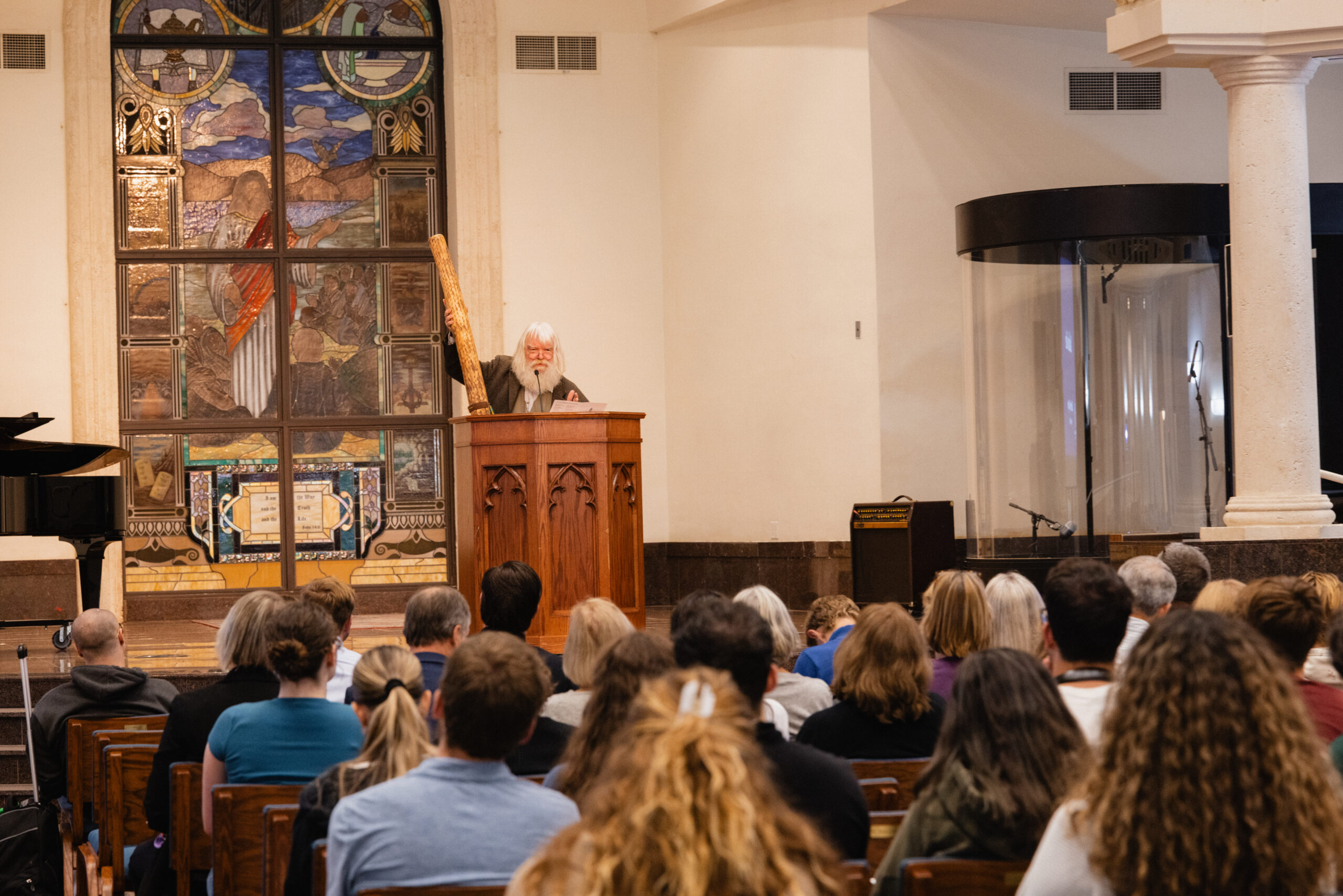
The lecture given by Guite focused on his analyzation of “The Rain Stick” by Seamus Heaney. Guite’s lecture became immersive as he read the poem out loud; with the addition of the visual and auditory aid of a rain stick. He bellowed through each stanza while he “upended” the instrument, as the work suggests. This musical motion provided an acoustic backdrop to the poem, which Guite explains is how it is meant to be read.
This method of reading deepened the lecture as he dissected the poem, discussing the metaphorical lines that hold the true meaning of the work. He assessed that the dry cactus seeds, which cascade inside of the stick to make a mesmerizing sound, are just like regular words. Just as those dry cactus seeds can be used to make a beautiful instrument, so can words be brought together to create contemplative works of art.
The poem emphasizes the long-standing beauty that the rain stick holds, Guite explained; it does not matter how many times it is played, it remains to be captivating. This idea can also be seen in poetry, since it is confined to being made up of words, but those words can be used repeatedly to create meaningful and differing conclusions.
Guite closed the lecture by discussing the religious aspects of the poem. He asserted that Seamus Hanely seems to imply that the rain stick, or perhaps poetry, can create a transcendent spiritual experience. The listener can hear a piece of heaven through the sound and meaning of the piece alone.
The Writing Workshop
While Malcolm Guite was at PBA he conducted more than just the lecture. He also held a writing workshop at Providencia Church where many students and faculty from PBA, along with members of Providencia’s local community, came to attend.
The workshop was an in-depth look at the art of poetry in its context historically, currently, and spiritually. Reading through various selections of poetry, some by himself, others by Seamus Hanley, and more; analyzing their unique artistry and how they use poetry to convey meaning.
Many of the dying arts in poetry were discussed, such as meter. Guite explains that many modern poets have lost touch with this musicality of poetry. With this saddening realization, he advocated for musicality to be brought back. He expressed that the beat of a poem is just like that of a movie score; it builds emotion in the audience and is essential to the piece’s affect.
In terms of academics, Guite explains poetry as the giver of life to scholarship. Poetry can take contemplative philosophical or theological ideas and transmit them into a melodic expression of complicated topics. In this way, poetry is a long meditative process to try and discover what the words want to say. The objective is to create out of what comes from silence and learn to mimic the enchanted utterances that God breathed into our world.
Impact and Future Pursuits
The Provost’s Distinguished Scholar Committee hopes that Malcolm Guite’s time at PBA was a blessing to all who were able to experience and hear some of his artistic and religious wisdom. As Guite himself expresses desire for his work to inspire people to pursue the relationship between art and spirituality, using one’s unique voice to communicate a human complexity in the ease of the Spirit.
Malcolm Guite is still contributing to the academic and artistic world as he will soon release volume one of his much-anticipated masterwork, “Merlin’s isle: Galahad and the Grail.”
Learn more about upcoming events at https://www.pba.edu/events/.