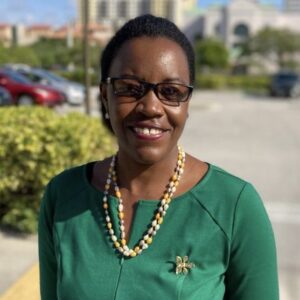
Dr. Wanjiru Gitau, assistant professor of practical theology and world Christianity at Palm Beach Atlantic University’s (PBA) School of Ministry, attended the World Evangelical Alliance General Conference in Seoul, South Korea, and participated in a panel discussion on Africa’s growing role in the evangelical world.
The Gospel to Everyone
This general assembly is held every six years and features sermons, workshops, panels, and business meetings focused on encouraging and strategizing the spread of the Gospel message. It is one of the largest international evangelical events, with the 2025 gathering featuring about 900 delegates from more than 120 countries, along with thousands of Korean pastors, scholars, and other church leaders in attendance. This year’s theme was “The Gospel to Everyone by 2033,” reflecting the organization’s goal to have the Good News reach every corner of the earth by the 2,000th anniversary of Christ’s death and resurrection.
“The thing about events like this is you really see just how much God is doing,” Gitau said. “I am always animated, energized, and excited to participate in a global group of people from every nation, tribe, and tongue, worshipping the Lord Almighty together.”
Gitau participated in a panel closely related to the assembly’s theme, titled “Living the Gospel in Global Growth,” which focused on recent evangelical growth in Africa. This topic is close to Gitau’s heart because she was born and educated in Kenya. She spent several years of her career participating in an international research project, the Africa Leadership Survey, which assessed the governmental, societal, and cultural aspects of various African nations and their links to the church.
A Refreshed Perspective of Africa
“I am always doing what I can to help redefine the narrative of how people see and talk about Africa,” Gitau said. “Too often, Africa is portrayed solely through the lens of civil unrest or adverse natural conditions such as disease or famine.” While she acknowledges these problems and their importance, she believes more people need to be educated about the African demographic landscape, which she says has vast, untapped potential.
As the continent expands, the average age of the population becomes younger. This stimulates economic growth, creating stability and helping to build a new middle class. Gitau explained that people—not resources—are Africa’s “wealth,” and that they will help drive the continent toward greater development across all spheres. This fuels what Gitau calls “a new scramble” for Africa, in which different countries, industries, and media platforms compete to seize infrastructure opportunities across the continent.
A Redefined Mission
“The question is: If the rest of the world is re-engaging with Africa as a continent on the rise, what is the church doing?” Gitau charged.
Gitau has studied the significant increase in church growth across all denominations in Africa. Instead of seeing this increase as a sign that missions are no longer needed, she sees it as an indicator that it is time for the global church to reinvest in already existing structures in the mission field. While she acknowledges that the previous era of missions was defined by pioneers entering new territory for the Gospel, she urges the global church to view 21st century missions as rooted in cooperation and partnership with established communities, churches, and development and humanitarian efforts. Gitau believes missions, using these principles, can benefit the people in more ways than just spiritually.
These missions would combine daily care—addressing challenges such as health care, food supply, and educational resources—with the spread of the Gospel’s message. Gitau dreams of a renewed effort by the church to help promote human flourishing, alongside providing eternal hope.
“As far as Africa is concerned, I hope more and more of our students can engage there,” said Gitau, who has been teaching at PBA since 2021. “That’s where the opportunities for these redefined missions—ones centered on solving human problems and finding a better way of bringing hope to people—exist.”
To learn more about PBA’s School of Ministry, click here.