From June 8 to 12, Palm Beach Atlantic University (PBA) faculty, staff, and volunteers facilitated an immersive science camp for students in grades one through 12.
This year, the theme for the annual Science Camp (Grades 1-5) and Summer Science Institute (Grades 6-12) was forensics, which challenged students to engage with multiple scientific disciplines through a creative and hands-on approach.
Daily Mysteries
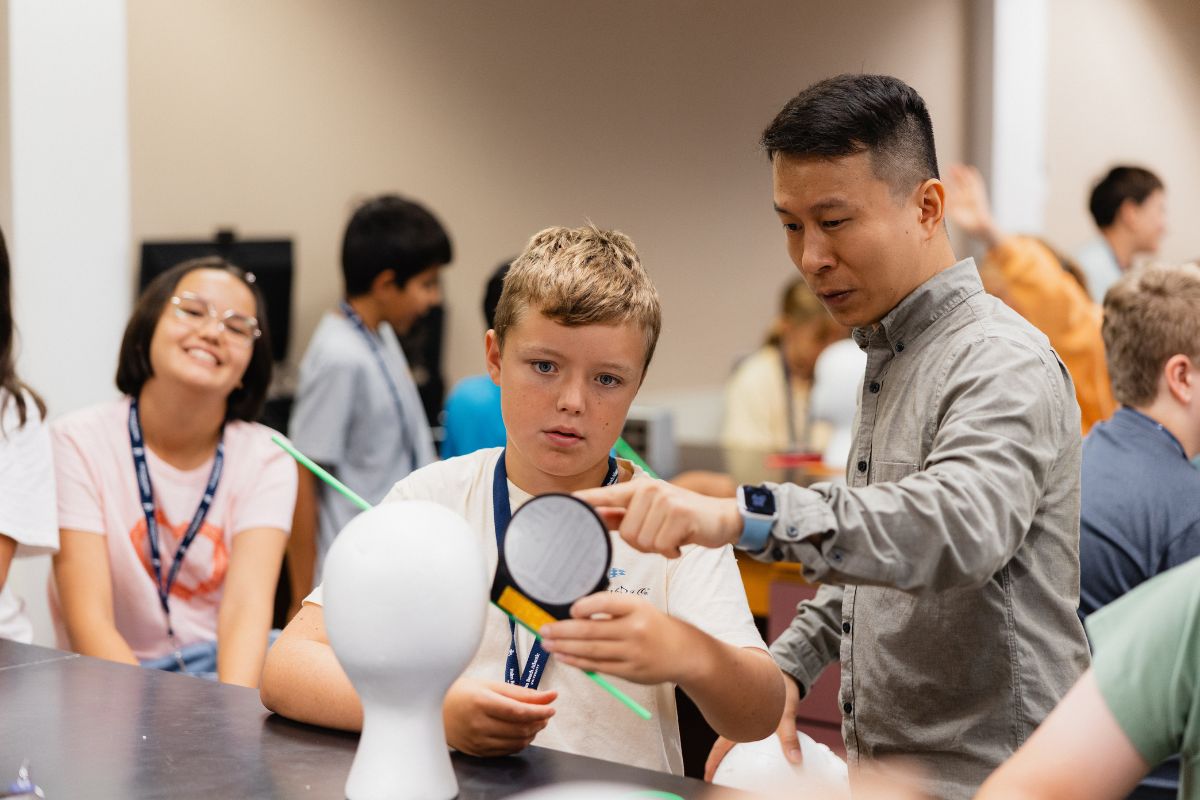
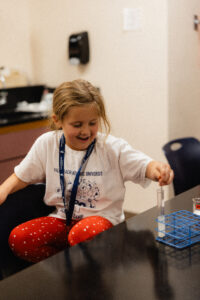
Science Camp participants were given daily mysteries to solve while the senior grade groups took a topical approach. Both groups’ explorations took them into laboratories and across campus to gain scientific skills in chemistry, microscopy, biology, and physics. PBA faculty led experiments and activities were facilitated by PBA college student camp counselors.
“We learned what trace evidence is,” said eight-year-old Titus Dennis, and explained an experiment his group conducted to extract DNA from strawberries. “It’s evidence left behind by the culprit.”
Other experiments included testing water and soil samples for contamination, comparing hair samples, and dusting for fingerprints. The latter experiment was led by PBA alumna Taj Laing, who graduated with an undergraduate degree in forensic science in 2018 and has worked with the West Palm Beach police department’s crime scene investigation team since then.
“It’s amazing to see how much PBA has grown and to give back,” said Laing, setting out swabs and cups to prepare for the experiment.
Walking Through a Crime Scene
Summer Science Institute participants listened to brief faculty and guest lectures and enjoyed experiments, including microscopic testing of samples for trace evidence, using trigonometry to determine the height, angle, and direction of spatters of liquid, and learning to use conductivity probes to measure other data left behind in a crime scene.
They also gained skills in forensic entomology and anthropology by studying bugs and bones to determine time of death, gender, age, and other details that might prove useful in an investigation.
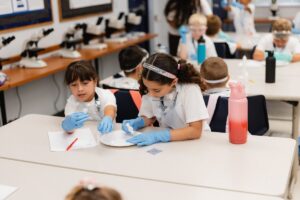 “God created a world with order, patterns, and truth,” said Assistant Professor of Engineering Dr. Terry Weng in a lecture, connecting science to faith. “What does the evidence tell us?”
By interacting with faculty and making use of the lab equipment, participants not only received a hands-on introduction to scientific disciplines and scientific career opportunities, but they also had the opportunity to become familiar with what the University has to offer to prospective students.
“We want to get people engaged and interested [in science] because that’s how we make advancements and grow the economy,” said Dr. Fred Browning, chair of PBA’s engineering department, who has led and organized the camp for the past seven years. “For example, Palm Beach County is booming in this new field of quantum computing. It’s going to accelerate AI, it’s going to accelerate everything, and it’s growing in our county—and so we need trained people in electrical engineering, system engineering, and physics.”
Putting it into Practice
Both groups had their skills put to the test on the last day. Science Camp participants entered a “mystery room” where they collected and tested trace evidence to solve and unlock clues. After solving the mystery of the stolen cookies, they celebrated by passing the plate around for everyone to enjoy.
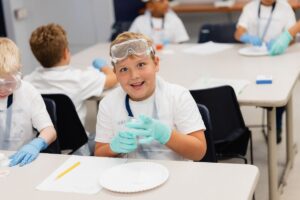 Summer Science Institute participants were similarly challenged to solve a mystery, but in their case, it was examining and piecing together the evidence in a realistic crime scene. Within each grade group, students were paired into teams to find and analyze various samples and, by sharing their findings with each other, collectively solve the case.
“The professors are very generous,” said Assistant Professor of Biology Sara Browning, who designed the experiments for the week. “We appreciate them joining us in this endeavor, as well as the PBA students who are counselors. We couldn’t do it without them.”
The Science Camp’s activities were supported by a $20,000 grant, which funded the purchase of new science equipment and necessary supplies.
Learn more about PBA’s science programs within the School of Liberal Arts and Sciences: https://www.pba.edu/academics/schools/liberal-arts-sciences/.