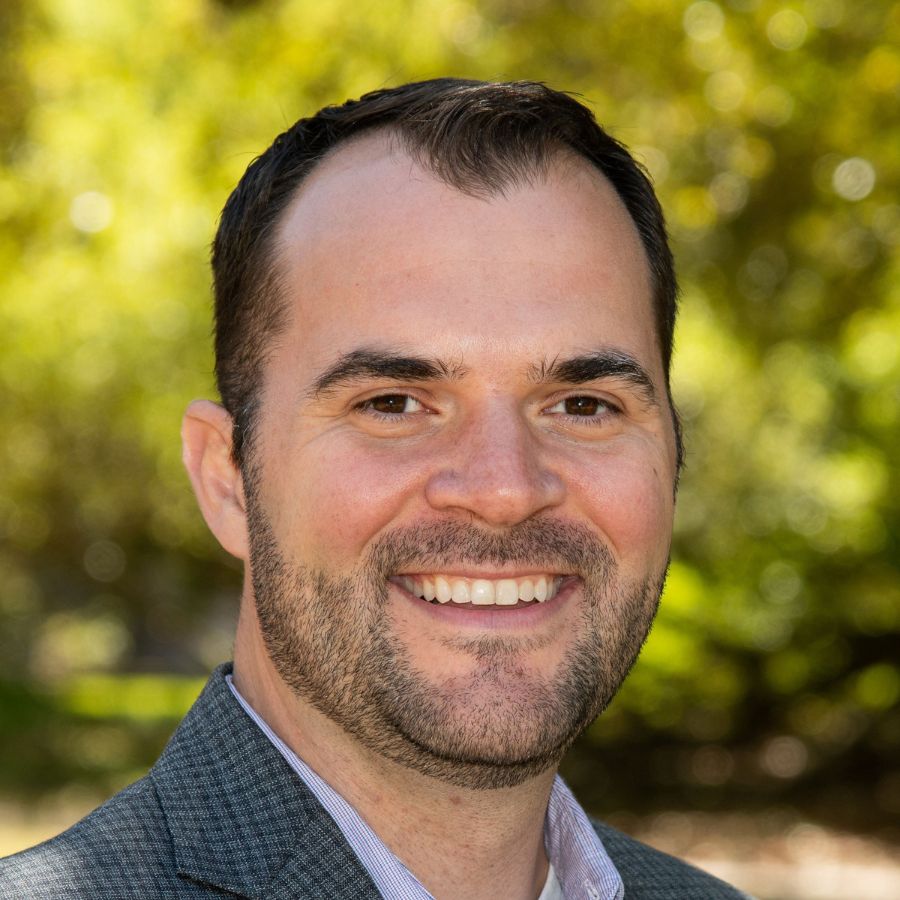
Dr. Nathaniel Hill wants students to see business beyond the borders of the United States.
As assistant professor of international business at the Rinker College of Business, Dr. Hill just completed his first year at PBA. He teaches a required course for business students called Global Business, introducing them to the ways companies operate across countries. The course covers trade theory, globalization, tariffs, international strategy, and the challenges businesses face when they expand into new markets.
For Dr. Hill, the goal is not only to teach students how international business works. It is to help them think more broadly, more critically, and more independently.
“My goal with the class is just to break students out of their U.S. bubble,” he said.
Dr. Hill joined PBA in July 2025 after completing his Ph.D. in international business from the University of South Carolina. Before entering doctoral studies, he spent about 11 years in the workforce, most of that time in economic development with nonprofit organizations that had international operations. His professional experience included working with Hope International and living in the Republic of Congo with his wife for two years.
That season shaped his understanding of business, faith, and the world.
“When I lived over there and spent so much time over there, you just realize how much different life can look like in another country, and even how much different business looks like in another location,” Dr. Hill said.
Thinking Beyond One Perspective
Dr. Hill’s Global Business course is designed to help students wrestle with complexity.
Through case studies and debates, students are asked to step into assigned roles, such as a company, the U.S. government, an activist group, or a free trade economist. From there, they must argue from that perspective and consider how the same issue can look different depending on where a person stands.
The debates push students to develop their own views, rather than simply repeat what they have heard from others. Dr. Hill does not want to tell students what to think. He wants to teach them how to think.
“I hope that they step away thinking, in his class, he challenged me to think for myself,” he said.
That kind of independent thinking, Dr. Hill said, is essential for future business leaders. In the workplace, organizations need people who can evaluate complex problems, ask better questions, and make ethical decisions under pressure.
An Opportunity to Live Out Faith and Invest in Students
Dr. Hill was drawn to PBA because of the opportunity to invest deeply in students. As a graduate of Trevecca Nazarene University, a Christian institution in Nashville, Tenn., he remembers the impact of professors who knew him personally and continued to invest in him beyond the classroom.
“At PBA, it makes it a little easier to do that than some other schools, with the smaller classrooms, just being a smaller school,” Dr. Hill said. “The fact that it’s a faith-based institution means that’s now a part of my life that I can share more openly and easily with students.”
He has already seen the value of student initiative. One student struggled after the first test in Global Business but took the initiative to visit Dr. Hill during office hours. They talked through what needed to change. The student followed through, worked hard, and finished the semester with a B in the class.
By the end, Dr. Hill said, the student delivered the best presentation in the class.
Those moments are part of why he wanted to teach.
“It was awesome to see the work you put into it,” he recalled telling the student. “You earned this grade.”
Preparing Leaders With Biblical Ethics
This year, Dr. Hill said one of the accomplishments he is proud of is the work that the Rinker College of Business faculty have done to review and update curriculum across several majors. He was part of the effort to update the international business major, which he believes will offer students courses that are more current, useful, and engaging.
That preparation matters, he said, because students will one day face difficult decisions in real time.
“When you are in the moment, having to make those decisions under pressure—even if you’ve never thought about it before—you’re going to be more inclined to make a hasty decision that maybe is not well aligned with your own beliefs,” Dr. Hill said.
By helping students think through those questions now, Dr. Hill believes he can prepare graduates who can lead with sound judgment and ethics. At the Rinker College of Business, Hill said, students are prepared to “take leadership roles in business, and lead with a strong sense of ethics based on a biblical worldview.”
Click here to learn more about the Rinker College of Business.