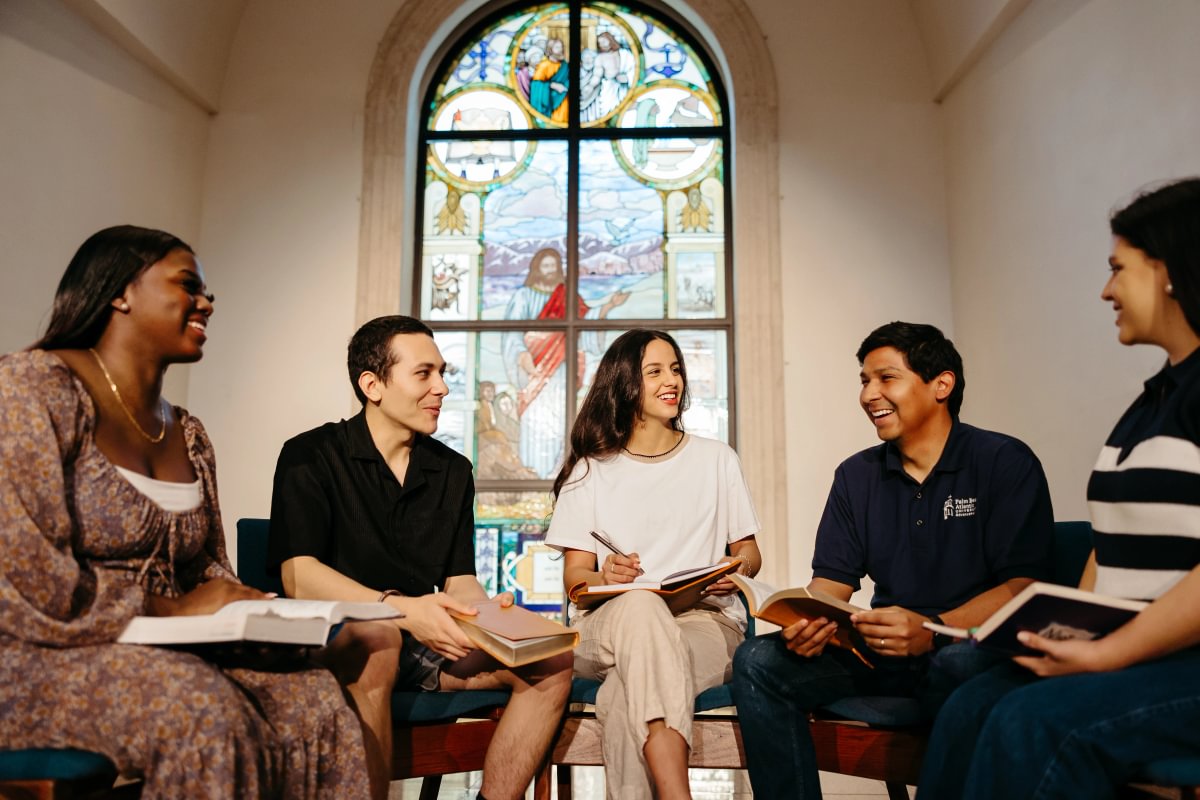
As we approach Christmas, it is a great time to pause and reflect on the significance of the season. In this article, Palm Beach Atlantic University’s (PBA) Dr. Jonathan Grenz shares how the tradition of Advent provides that perfect space for reflection. By honoring this tradition, each of us can joyfully remember the true meaning of Christmas—the hope we have in Christ’s birth and His gift of salvation.
People Get Ready! The Importance of Advent
I did not grow up observing Advent. I first experienced observing it in college. Perhaps your experience is similar, and Advent is somewhat new for you. In our busy lives, it encourages us to slow down, renew our spirits, and live with hope. Advent is more than just a counting down to Christmas; it asks us to reorient our hearts back to Christ.
Advent began to be observed in the fifth century. Initially, it resembled Lent, focusing on fasting and repentance. By the sixth century, Advent became the four Sundays leading up to Christmas. Over time, the focus on penitence decreased, giving way to a more joyful expression.
Advent had two main focuses: joyful anticipation of Christ’s birth and sober readiness for His return. Today, you likely hear more about the joy of Christ’s birth, but that does not mean Advent is unrelated to His return. Traditionally, the first two Sundays highlighted Christ’s return with an emphasis on repentance, while the last two Sundays shifted toward His birth.
Why the World Needs Advent
The Advent themes of hope, peace, joy, and love appear throughout Scripture. While hope and peace often reflect the Hebrew people waiting for the Messiah, they also connect to our anticipation for Christ’s return. As a pastor, it was challenging to preach about hope and peace during Advent due to the conflicts and tragedies in the world, and the pain many in my church felt. However, when we focused on Christ’s return, we could find hope and peace, knowing that His return will bring us all four themes in perfect fullness. Joy and love center on the birth of Jesus. God’s entry in this world in Christ’s birth gives us true joy and ultimate love.
In our fast-paced culture, Advent offers a different rhythm that encourages us to slow down and live with purpose. This season acts as a spiritual reset that reorients our lives back to God’s promises. To illustrate this, Advent marks the start of a year new in the liturgical calendar, resetting the “church’s clock”. How do we reorient ourselves? It starts by engaging practices that deepen our awareness of God’s presence like prayer and reading and reflecting on Scripture.
A Season of Serving Others
Advent also involves acts of compassion. In the fifth century, Pope Leo the Great said that fasting should be accompanied by generosity. Advent asks us to prepare not only our hearts but also our communities for Christ’s coming by showing compassion. In a world filled with anxiety and division, Advent proclaims that history is moving toward God’s peace. By adopting hope-filled practices, Advent shapes our hearts to celebrate not just Christ’s birth but also to wait for the renewal of all things at His return.
Advent is a season to prepare for Christ’s coming and to hold onto hope for God’s future. By embracing its call to pay attention and renew ourselves, we enter a rhythm that changes both our hearts and the world. This year, let Advent reset your clock and renew your hope.
 With over 30 years of ministry experience, Dr. Jonathan Grenz is dean of PBA’s School of Ministry and the Catherine T. MacArthur School of Leadership. Before that, he was director of PBA’s Master of Divinity program and assistant director of the Center for Experiential Learning. Grenz has served as lead pastor, associate pastor in youth ministry and Christian education, and parachurch ministry director. He was a full-time faculty member at Sioux Falls Seminary and an adjunct professor at Taylor University, College and Seminary in Edmonton, Alberta, Canada. He has led numerous short-term missions and recently has taught pastors in Colombia, Nigeria, the Philippines, and Ukraine. He also served as president of the We Are Life board of directors and co-authored Synergistic Collaborations: Pastoral Care and Church Social Work. Grenz is passionate about mentoring and equipping young Christian leaders for the church and the world.