Established over a decade ago, Palm Beach Atlantic University’s (PBA) Summer Undergraduate Research (SUGAR) program provides students with the opportunity to work with faculty advisors on formal investigations into a variety of disciplines.
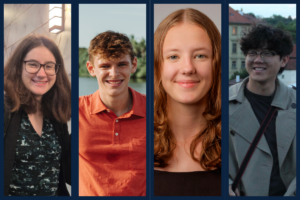
The program is managed by Dr. Robert Hegna, associate professor of biology, who helps students explore the range of undergraduate scholarships. Lydia Kuerth, Brayden Monthei, Ruth Spijker, Joseph Yuen, and Ethan Newell were each chosen to participate in the 2026 SUGAR Program. This year’s students investigated English literature, new technology, bacterial behavior, mangrove restoration, and Florida red tide.
Lydia Kuerth: Continuing the Story
Kuerth, a senior English major with a concentration in professional writing, was interested in discovering the influence of Sir Walter Scott on American writers. Kuerth was invited to the SUGAR program for this project by her English professor, Dr. Jenifer Elmore.
Together, Kuerth and Dr. Elmore, were able to discover several unknown references and connections between Scott, a Scottish author, and Catherine Sedgwick, an American writer. They produced a substantial database that can now be used for further historical literary investigation and presented their findings at the Joint Symposium of the Catharine Maria Sedgwick and Lydia Maria Child Societies.
“Often keeping track of minor details allowed me to notice connections and draw conclusions that other scholars hadn’t noticed before,” Kuerth said.
Brayden Monthei: A New Dimension of Technology
Monthei, a senior computer science major, worked with mathematics professor Dr. Jesse Adamski to develop software capable of processing differential equations with a rise in dimensions. Through rounds of programming and testing, he developed multiple 2D and 3D models that can be used to explore mathematical behavior in the fourth dimension, which cannot be directly observed.
“This project really made me think outside the box,” said Monthei. “Every bug I had to fix was more than what could be seen on the surface.”
Ruth Spijker: Discoveries the Eye Can’t See
Spijker, a senior medicinal and biological chemistry major, investigated “unusual cannibalism.” A phenomenon in which bacteria kill neighboring cells to obtain nutrients. Her work with Dr. Maddison Melchionna, a professor of biology, helped generate valuable data for choosing the best experimental procedure to investigate certain bacterial behaviors.
“SUGAR gave me the opportunity to work in the lab independently, allowing me to develop crucial skills such as planning experiments and adapting when the experiments did not go as expected,” said Spijker.
Joseph Yuen: Restoring the Coast
Yuen, a senior biology major with a concentration in botany, environmental science, and field biology, wanted to research developing standardized methods for measuring the success of mangrove restoration.
Yuen did hands-on field and laboratory research on mangrove and seagrass monitoring, sediment collection, hydraulic-conductivity and grain-size testing, organic-matter analysis, and data collection at multiple restoration sites. Working with biology professors, Dr. Rachel Harris and Dr. Thomas Chesnes, he built a dataset and methodological framework that can be used to support future research.
“There are so many more elements to restoration projects than one would think,” said Yuen. “It made me greatly appreciate the people actively working to monitor and restore mangrove communities.”
Ethan Newell: Turning the Tide
Newell, a first-year student at PBA’s Gregory School of Pharmacy, investigated the structure of RNA involved in Karenia brevis, the organism responsible for Florida red tide. He produced publication-quality gem images while comparing different RNA sequences. Newell’s work contributes to his faculty advisor and professor of chemistry, Dr. Jackie Esquiaqui’s, larger research on environmental factors changing RNA structure and toxin reproduction.
To learn more about the SUGAR Program, visit here.